Cell-Cell Communication: The Neuromuscular Junction

Today marks the last article on neuronal communication. In the past two articles, we saw how neurons are able to transmit information with each other. Today, we will see how this information is used, mostly through the understanding of neuromuscular junction.

To understand how neuron use the information, we first need to understand where it is originally from. Simply put, neuronal information is a response to a stimulus. For example, if you are touched, sensory neurons on the skin will transform the touch into electrical information. This information will go to many places: first in the brain, to inform it that touch is happening, but then to other neurons in the perimeters to tell them that the touch is not painful and they should not activate. However, one of the main response to a stimulus is movement. Indeed, if for instance you were to touch something hot, the neurons will tell your hand to move it away from it. Neurons also tell you everyday to walk, use your lung muscles to breathe, etc… And most if not all movement starts at the neuromuscular junction [source].

The neuromuscular junction (NMJ) is a specialized synapse, but instead of a pre- and postsynaptic neuron, we have a presynaptic neuron and a muscle. In this scenario, the presynaptic neuron receives an action potential, which will travel down the neuron towards the NMJ. There, it will activate the release of neurotransmitters. In this case, the main neurotransmitter is acetylcholine (Ach). These neurotransmitters will bind to the receptors nicotinic acetylcholine receptors (nAchR) at the muscle membrane. When Ach binds, it causes an influx of ions, similar to any synapse. However, instead of creating an action potential, this influx of ion will cause muscle contraction, and initiate movement [source].

The example of NMJ can also show us the importance of neurotransmitters. Depending on which one is used, the information will be treated differently. Similarly, a neurotransmitter may have different receptors, and depending on which one is activated, the answer will be different. An example for this will be from specific neurons in the brain called medium spiny neurons (MSNs). These neurons are the customs of movement, they either allow or forbid it. Such drastic difference in response is explained by a difference in receptors. While all MSNs receive the neurotransmitter dopamine, some MSNs will express the dopamine D1 receptor, which will activate the movement, while the others express the dopamine D2 receptor, which will prevent it [source].

Overall, neuronal communication is a complex concept that mixes both electricity and chemistry. But while the mechanism is nearly always the same, the results can be drastically changed thanks to slight modification such as neurotransmitter use.
Cell-Cell Communication: The Synapses

Last week, we explained how a neuron can pick up information, and how this information is transformed into an electric current. Today, we will continue to see how the information travels, this time from one neuron to another, through a structure called the synapse.

The Synaptic structure

Let’s recap what we know from last week. A neuron has received information, and this information was transformed into an action potential thanks to the inflow and outflow of ions. This action potential travels down the neuron to the end, towards the synapse. The synapse is a structure that links two neurons. The neurons who is sending the information, or the presynaptic neuron, is very close to the neuron that will receive the information, or the postsynaptic neurons. this proximity is what allows the information to go from one neuron to another. However, the information will not be transmitted as an electric current; instead, it will become a chemical signal. In the presynaptic neuron, we can find small pockets, called vesicles, that contains molecules called neurotransmitters. We all know some neurotransmitters by name: dopamine and serotonin are examples. The role of a neurotransmitter is to transmit the information to the postsynaptic neuron. To better understand how it works, we will go through two examples: first the excitation of the neuron, then the inhibition of a neuron [source / source / source].

The Excitation of a neuron

In this example, the presynaptic neuron received an information telling him to « activate » the postsynaptic neuron. This is called excitation. The action potential will thus travel down to the synapse, and activate the release of neurotransmitters. It does so by again causing an influx of Ca2+ ions. There are many neurotransmitters that can excite a neuron, but the most common one in the brain is called glutamate. Now, once the vesicles have been opened, a lot of glutamate are found in the junction between the pre- and postsynaptic neuron, ready for action. At the postsynaptic neuron, we can find receptor specific for glutamate. There are two main one, AMPA receptor, and NMDA receptor. The glutamate will bind both, however AMPA receptor will activate first, causing an influx of positive ions inside the postsynaptic neuron. NMDA receptors will then activate, due to both glutamate and the influx of ions inside the cell, causing even more positive ions to enter the cell. In the end, the influx of ions have changed the membrane potential, depolarizing the neuron and creating a new action potential. This action potential will then travel down the neuron to the synapse, starting the cycle again [source / source / source].

The Inhibition of a neuron

Neuronal inhibition works similarly to excitation, but the results are different. Just as the name suggests, the presynaptic neuron will want to inhibit the postsynaptic neuron, preventing it from creating an action potential. To do so, we use another neurotransmitter, GABA. Once the presynaptic neuron has released GABA, it will bind to its receptor, aptly named the GABA receptor, and cause an influx of ions. This time however, it is an influx of negative ions, mainly Cl-. This causes the membrane potential to drastically decrease, causing hyperpolarization. It is then very hard for the postsynaptic neuron to create an action potential [source / source / source].

Learning and memory: How to be more efficient

Synapses also have the crucial role of causing learning and memory in humans. In terms of neuronal function, learning simply means that the neuron will perform its task faster and stronger than the last time it was used. There are many ways to do so, but the main one is to increase the number of receptors at the postsynaptic neuron, particularly AMPA receptors. With more AMPA receptors, the neuron will be depolarized faster, and the action potential will be created faster, making the overall information more rapidly conveyed. This particular form of learning and memory is called long-term potentiation (or LTP), and is the basis for all memory in the body. Another form of memory, called long-term depression (or LTD) actively reduces the amount of AMPA receptors, rendering the neuron slower [source / source].

Now we understand how the information goes from one neuron to another. But now what? Obviously, the information will not go from one neuron to the next indefinitely, there has to be a goal. Next week, we will talk about how the information is used, notably by talking about the neuromuscular junction, a special synapse converting electrical current into movement.

Cell-cell Communication: The Unique Case of Neuronal Connectivity

Today we will discuss an essential mechanism: cell to cell communication. Cell communication is very important for the survival of the organism. Humans, like most multicellular organisms, have developed many ways for cells interact with each other. Some, like skin cells, use chemicals to warn cells of potential dangers. Others, such as immune cells, will touch each other to transmit information. Neurons have a unique way of communication, which is arguably the fastest. They use electric currents. In this article, we will first talk about electric currents in the brain, to then understand what the current looks like in a neuron. Next week, we will see how neurons transmit this information and what they do with it.

Ions: The Basis of all currents

To understand electric currents of any kind, we need to establish what an ion is. Atoms are made of very small particles: neutrons (which have no electrical charge), proton (which have positive charges), and electrons ( which have negative charges). An atom has the exact same number of proton and electron, which creates an overall neutral charge. As an example the sodium atom (abbreviated Na), has 11 protons, an 11 electrons, so the electric charges cancel each other. An ion is an atom with an electric charge, usually do to a loss or gain of electrons. In the case of Na, the ion is abbreviated Na+, because it lost one electron, and thus it is now positive. The flow of ions in neurons is the key for its communication. The most important ions are Na+, the potassium ions (K+), the calcium ions (Ca2+, as calcium ions lost two electrons), and chloride ions (Cl-, having gained an electron, and thus is negative) [source / source].

The Basics of Electricity in the Brain

Before explaining how neurons communicate, there are two key concepts to understand. The first one, voltage, is the most complex. Officially, we define voltage as the amount of « work » is required to move a charge from one point to another. In simpler terms, a voltage (also called potential), is the amount of electrical « difference » between to points. For our neurons, the voltage will compare the inside of the cell to the outside. The inside of the cell is very negative, while the outside is very positive, and the overall voltage of the cell (which we call resting membrane potential) is -70 millivolts (mV). It means that overall, neurons are heavily negatively charged. The second important concept is current. A current quantifies how much electricity travels from one point to another. The more positive ions travel, the more positive the current will be and vice-versa [source / source].

The Concept of Action Potentials

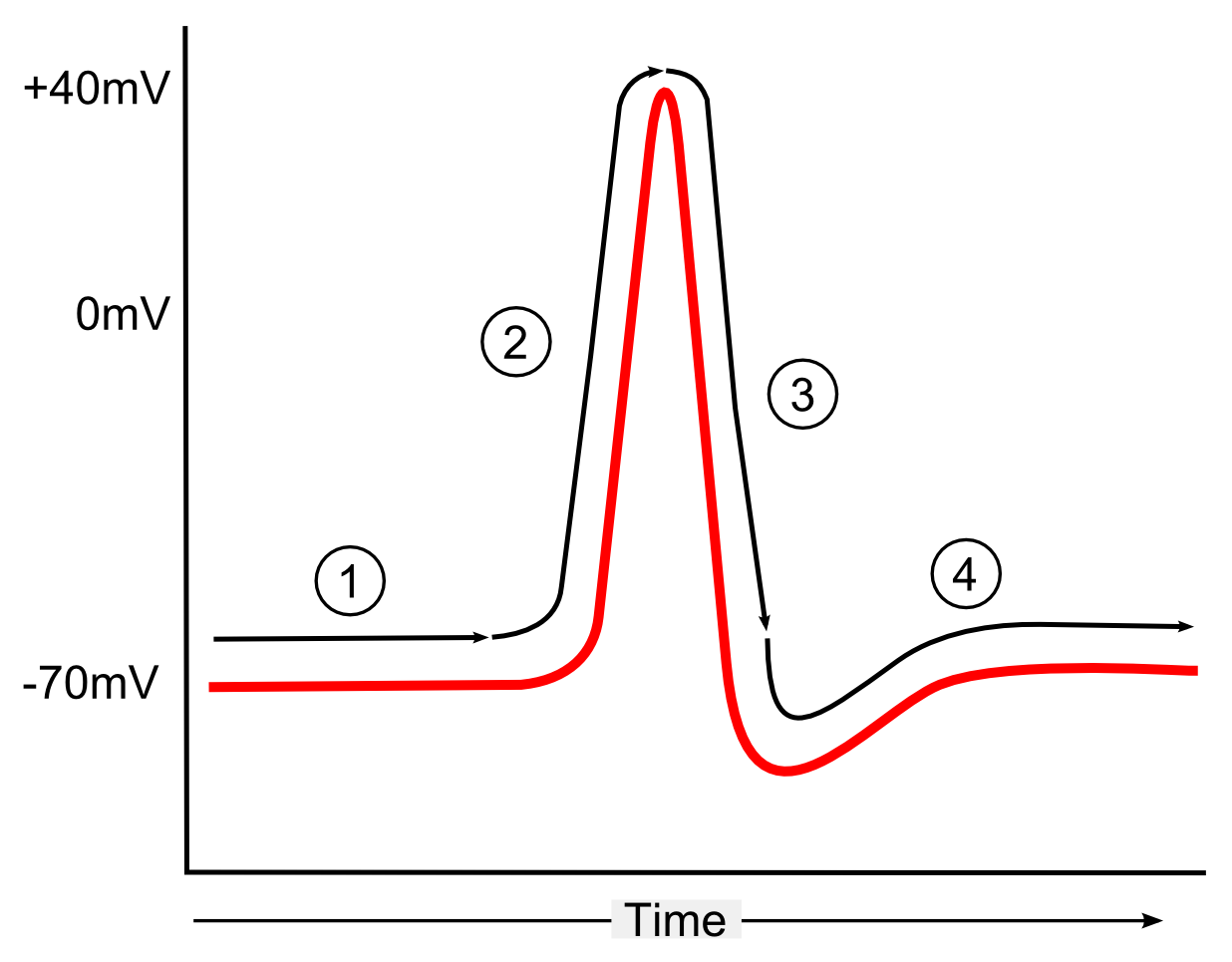
Now we will discuss how neurons communicate. When no information is transmitted, neurons have a voltage of -70 mV and a net current of 0 picoamperes (pA). We say net current because even though the overall current is 0, ions are still flowing in and out of the cell, but for any positive ions that leave, the same amount enters, creating a net current of 0 pA. Further, the inside and outside of the cell have different amount of ions. The inside of the cell has a lot more K+ ions, while the outside has more Ca2+, Cl-, and Na+. Due to this, K+ ions have the tendency to leave the cells, while the other will want to enter it. However at a resting state, only minimal amount of each ions will enter or leave the neuron. However, when the neuron is stimulated, it will create an action potential, which looks like this:

Image from Wikipedia Commons (https://commons.wikimedia.org/wiki/File:Action_potential_schematic.png)

Let’s go through the numbers: 1 is the resting state, where the voltage is the same. The neuron is then stimulated, and at 2, a large amount of Na+ enters the cell. The number of ions is so big that it changes the neuron’s voltage to about +40 mV. This is called depolarization. At 3, Na+ are unable to enter the neurons. Furthermore, the neuron will make a huge amount of K+ ions to leave the cell, to make the cell back to its resting potential (this is called repolarization). It goes even lower than that, to prevent another action potential to be created right away. This is called hyperpolarization, and it is important to prevent neurons to be to excited. At 4, the cell is back to normal. Action potentials are always the same, and they then travel down the neuron to the end, a place called a synapse [source / source / source / source].

Neuronal communication is complex, but it has so many advantages, the main one being speed. However, today we only saw how the information is created. Next week, we will see how the action potential goes from one neuron to another. We will also see how a neuron really interprets this information.