Today we will discuss an essential mechanism: cell to cell communication. Cell communication is very important for the survival of the organism. Humans, like most multicellular organisms, have developed many ways for cells interact with each other. Some, like skin cells, use chemicals to warn cells of potential dangers. Others, such as immune cells, will touch each other to transmit information. Neurons have a unique way of communication, which is arguably the fastest. They use electric currents. In this article, we will first talk about electric currents in the brain, to then understand what the current looks like in a neuron. Next week, we will see how neurons transmit this information and what they do with it.
Ions: The Basis of all currents
To understand electric currents of any kind, we need to establish what an ion is. Atoms are made of very small particles: neutrons (which have no electrical charge), proton (which have positive charges), and electrons ( which have negative charges). An atom has the exact same number of proton and electron, which creates an overall neutral charge. As an example the sodium atom (abbreviated Na), has 11 protons, an 11 electrons, so the electric charges cancel each other. An ion is an atom with an electric charge, usually do to a loss or gain of electrons. In the case of Na, the ion is abbreviated Na+, because it lost one electron, and thus it is now positive. The flow of ions in neurons is the key for its communication. The most important ions are Na+, the potassium ions (K+), the calcium ions (Ca2+, as calcium ions lost two electrons), and chloride ions (Cl-, having gained an electron, and thus is negative) [source / source].
The Basics of Electricity in the Brain
Before explaining how neurons communicate, there are two key concepts to understand. The first one, voltage, is the most complex. Officially, we define voltage as the amount of « work » is required to move a charge from one point to another. In simpler terms, a voltage (also called potential), is the amount of electrical « difference » between to points. For our neurons, the voltage will compare the inside of the cell to the outside. The inside of the cell is very negative, while the outside is very positive, and the overall voltage of the cell (which we call resting membrane potential) is -70 millivolts (mV). It means that overall, neurons are heavily negatively charged. The second important concept is current. A current quantifies how much electricity travels from one point to another. The more positive ions travel, the more positive the current will be and vice-versa [source / source].
The Concept of Action Potentials
Now we will discuss how neurons communicate. When no information is transmitted, neurons have a voltage of -70 mV and a net current of 0 picoamperes (pA). We say net current because even though the overall current is 0, ions are still flowing in and out of the cell, but for any positive ions that leave, the same amount enters, creating a net current of 0 pA. Further, the inside and outside of the cell have different amount of ions. The inside of the cell has a lot more K+ ions, while the outside has more Ca2+, Cl-, and Na+. Due to this, K+ ions have the tendency to leave the cells, while the other will want to enter it. However at a resting state, only minimal amount of each ions will enter or leave the neuron. However, when the neuron is stimulated, it will create an action potential, which looks like this:
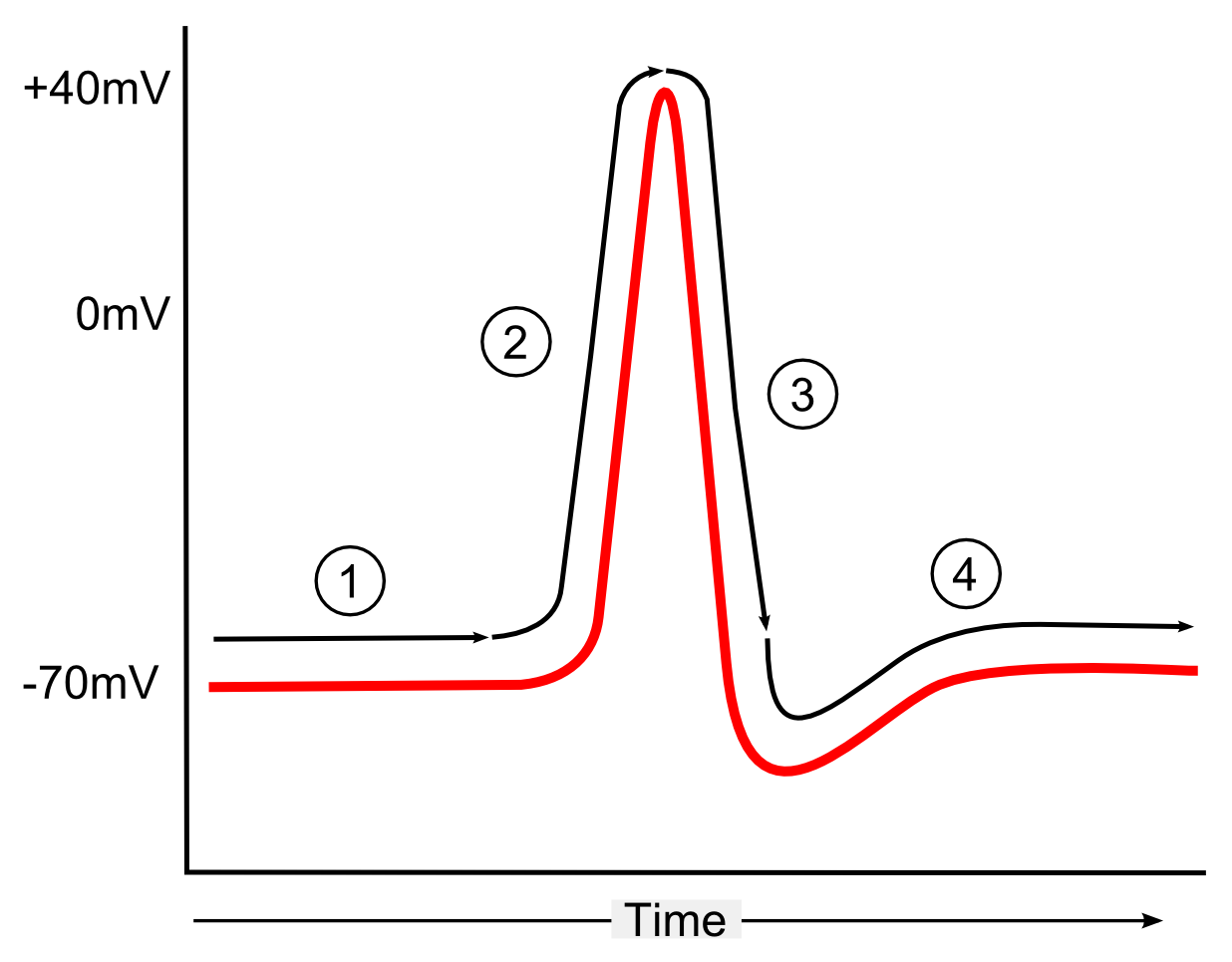
Let’s go through the numbers: 1 is the resting state, where the voltage is the same. The neuron is then stimulated, and at 2, a large amount of Na+ enters the cell. The number of ions is so big that it changes the neuron’s voltage to about +40 mV. This is called depolarization. At 3, Na+ are unable to enter the neurons. Furthermore, the neuron will make a huge amount of K+ ions to leave the cell, to make the cell back to its resting potential (this is called repolarization). It goes even lower than that, to prevent another action potential to be created right away. This is called hyperpolarization, and it is important to prevent neurons to be to excited. At 4, the cell is back to normal. Action potentials are always the same, and they then travel down the neuron to the end, a place called a synapse [source / source / source / source].
Neuronal communication is complex, but it has so many advantages, the main one being speed. However, today we only saw how the information is created. Next week, we will see how the action potential goes from one neuron to another. We will also see how a neuron really interprets this information.
 The Science Decanter
